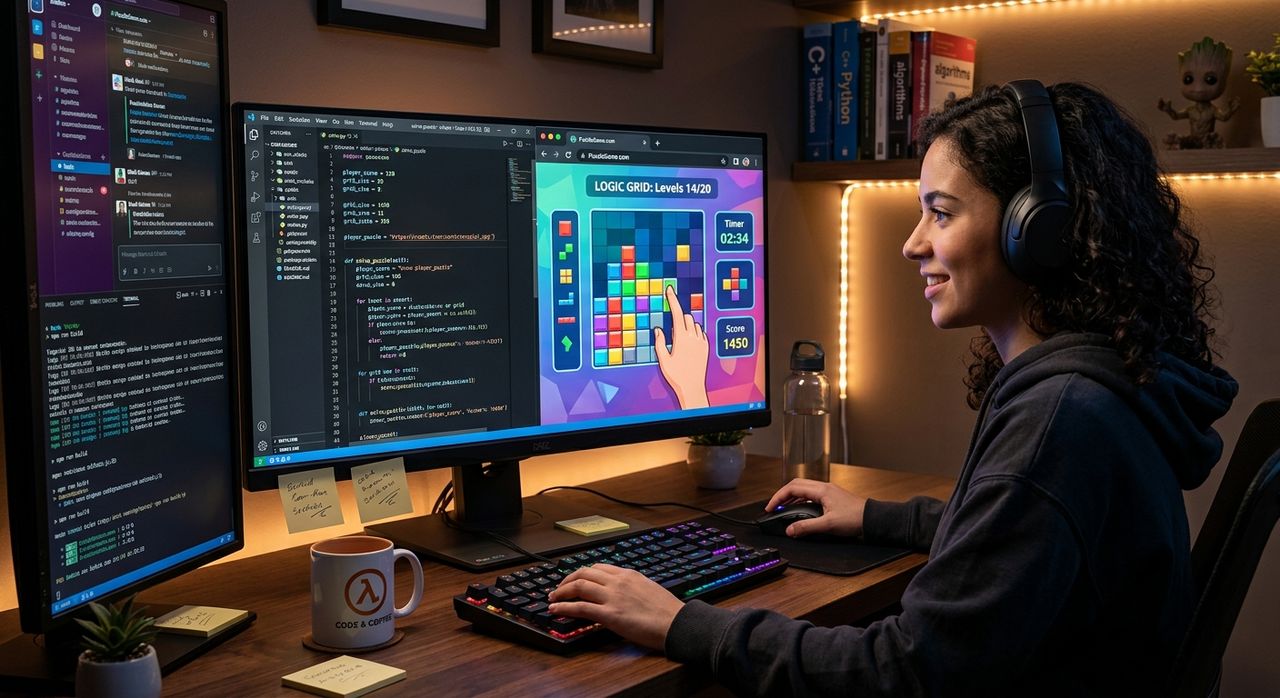
Most developers know the feeling. You hit a wall mid-afternoon, the code is fighting back, and your brain clearly needs a pause. The easiest thing to reach for is a new tab and a social media feed. Except those few minutes stretch into twenty, and when you finally return to your editor your head feels more cluttered than before. Browser puzzle games offer a different kind of break, one that lets your mind breathe without completely switching off the part of your brain that solves problems.
Key Takeaway: Browser puzzles give PC users a focused mental reset that social media simply cannot deliver. Games like 2048 mirror the logical thinking developers already practice daily, while visual grid puzzles sharpen the pattern-recognition skills that feed directly into front-end and UI work. A five-minute puzzle break keeps the brain running in a logical mode rather than draining it completely, making it far easier to slide back into a coding flow state than any doom-scroll session ever could.
Why Social Media Is the Wrong Break for a Developer
There is a reason that opening Instagram or Twitter between coding sessions rarely leaves you feeling refreshed. Social media is engineered for endless consumption. Each scroll is designed to pull you further in, presenting content that triggers just enough curiosity or mild outrage to keep you from closing the tab. That is the opposite of what a developer needs from a break.
What a productive break actually does is reduce cognitive fatigue without wiping out your working context. Research on attention restoration, formalized in attention restoration theory, suggests that brief diversions work best when they are low-stakes but still gently engaging. You want something that occupies the restless part of your mind without demanding the same deep focus your code does. That sweet spot is exactly where browser puzzle games live.
The beauty of a browser game is the zero friction involved. There is no app to install, no account to create, no loading screen to endure. You open a tab, play for a few minutes, and close it. The session ends when you decide it ends, not when an algorithm nudges you toward another video.
Merge-Chain Logic That Mirrors Real Developer Thinking
The most common reason developers gravitate toward 2048 during a coding break is that it speaks the same language their work does. Sliding into a 2048 puzzle session means working with numbered tiles on a four-by-four grid where you can push everything in one of four directions, left, right, up, or down. Matching tiles merge and double in value. The goal is to reach the 2048 tile before the grid fills up and stops you cold.
On the surface that sounds simple. In practice, it demands a form of spatial reasoning that feels immediately familiar to anyone who has ever worked with arrays, trees, or priority queues. You are constantly thinking a few moves ahead, mentally modeling how one shift will cascade into a chain of merges. That is not so different from tracing how a state change propagates through a component tree or how a sort algorithm reorganizes a data structure.
This is precisely why 2048 works as a mental reset rather than a full stop. It keeps the logical reasoning circuits warm without hammering the exact problem you are trying to step away from. You are still thinking in sequences and consequences, but with none of the stakes attached to your actual code. By the time you close the tab, the break has done its job and your brain is still in gear.
The Right Mindset for a Five-Minute Session
The trap most people fall into with puzzle games is letting five minutes become thirty. A couple of habits help prevent this. Setting a visible timer before you start is the most reliable method. Another approach is treating the game like a deliberate tool rather than an escape. You are not playing because you want to avoid your work, you are playing because you know it will make the next thirty minutes of coding more productive.
Mental fatigue builds up during sustained focus, and short diversions can partially restore your capacity to concentrate. The key is that the diversion should be genuinely different from the primary task without being completely passive. Passive stimulation, like scrolling through an endless feed, tends to deplete rather than restore. A puzzle with a clear objective and a defined end state gives your brain something to close out. There is a natural satisfaction in finishing a round, even a short one, that a social media scroll never provides.
Visual Logic Puzzles and Pattern Recognition for Front-End Work
If 2048 appeals to the data structure side of developer thinking, nonograms appeal to the visual logic side. Pulling up a nonogram grid means facing a blank playing field with number clues running along the rows and columns. The numbers tell you how many consecutive filled cells appear in each row or column, but not where those runs start. Your job is to use logic and process of elimination to fill in the correct cells.
Nonograms originated in Japan in the late 1980s and have been well documented as a form of binary constraint satisfaction. According to the Wikipedia entry on nonogram puzzles, they gained widespread popularity after appearing in Japanese puzzle magazines before spreading globally through newspaper puzzle sections and eventually browser-based formats.
For front-end and UI developers specifically, the skill a nonogram trains is unusually applicable to daily work. Solving one forces you to hold a mental model of negative space alongside positive space. You are thinking about what is not filled in just as much as what is. That binary grid reasoning, where you evaluate what belongs in a cell and what does not, translates directly to how you evaluate element placement, whitespace, and layout structure in a design. After hours of staring at syntax, solving something visual and spatial feels like a genuine change of pace even though the underlying reasoning is still structured and logical.
What Makes Browser Format the Right Container
Not every game belongs in a browser tab during a work session. The browser format works specifically because of the constraints it imposes. There is no save file to manage, no narrative to track between sessions, no skill tree to grind. Each session is self-contained.
This matters because it eliminates the psychological cost of stopping. With a single-player RPG or a strategy game, stopping mid-session creates a small but real sense of unfinished business. That is exactly the kind of mental overhead you do not need when you are trying to return to a demanding coding task. A browser puzzle lets you walk away cleanly.
These are the qualities that make a browser puzzle genuinely useful during a work break:
- Sessions are short by nature and do not punish you for stopping at any point
- No account, no history, no social pressure to compete or compare scores
- The game starts immediately with no loading or setup friction
- The logic is self-contained within one screen so context is never lost between visits
- The challenge scales naturally within a single session rather than requiring prior session knowledge to stay engaged
The Attention Restoration Factor
Directed attention, the kind you use for debugging or architecting a feature, is a limited resource that depletes over time. Restoration happens when you shift to a task that demands soft fascination rather than directed concentration. Puzzle games sit in an interesting middle ground. They are not purely restorative in the way a walk outside might be. But for developers who find nature walks inconvenient between commits, they offer the closest practical alternative available inside a browser tab.
The key is choosing a puzzle that engages without overwhelming, something with clear rules, a visible goal, and a session length you control. Both the tile-merging logic of 2048 and the binary fill patterns of nonograms fit that description precisely. They hold your attention without hijacking it.
Reclaiming the Developer Break
The coding break has become a neglected piece of the developer workflow. Most productivity advice focuses on the work itself, the tools, the workflows, the debugging habits. The quality of the break rarely comes up. But the break shapes what comes after it just as much as any linter setting or keyboard shortcut.
Switching from a mindless scroll to a purposeful puzzle is a small change with a disproportionate return. Your break still feels like a break. You still step away from your current problem. But when the timer ends and you return to your editor, you come back with a mind that has been resting on familiar logical terrain rather than scattered across a hundred unrelated emotional inputs.
That is the real reason PC users keep puzzle tabs pinned alongside their development tools. Not because the games are addictive, not because any leaderboard is tempting, but because five minutes of the right kind of thinking is worth far more than twenty minutes of the wrong kind.