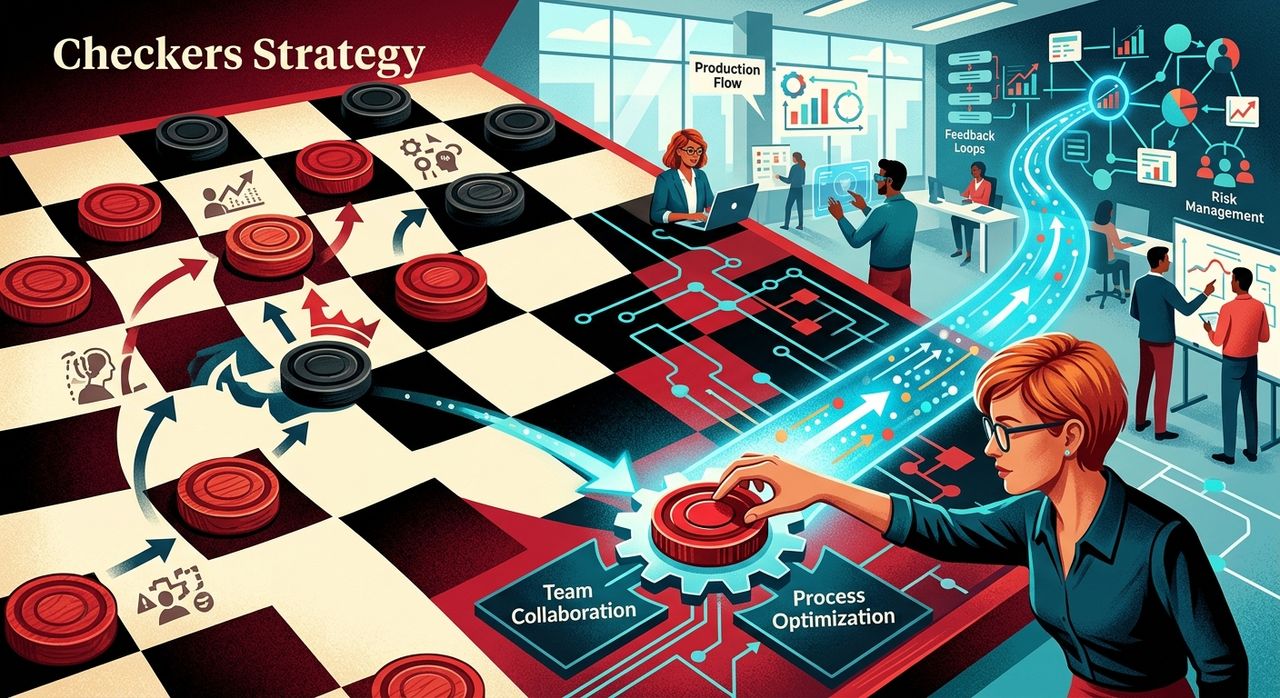
Checkers looks simple. Two colors, one type of piece, moves that go in a single diagonal direction. But sit across from a strong player and something shifts. Suddenly you are not just reacting. You are reading three moves ahead, calculating which trades are worth making, and deciding whether controlling the center of the board matters more than keeping all your pieces intact. That is exactly the kind of thinking that separates mediocre systems from ones that scale.
Key Takeaways:
- Forcing trades in checkers mirrors the architectural decision to absorb short-term complexity for long-term gain
- Backward induction, thinking from the desired end state backward, applies directly to scalability planning
- Positional advantage in checkers and in software both require giving something up first
- Classic games model multi-variable thinking in a format that is fast to learn and easy to share
- Comparing games by rule complexity gives teams a useful shorthand for assessing system risk
The Trade That Does Not Look Fair
In checkers, experienced players often force a trade that looks like a bad deal on the surface. You give up a piece to remove two of your opponent's pieces from the center. You take a short-term loss to gain positional leverage. The board count is now slightly against you, but your remaining pieces control the squares that matter.
This is not luck. It is strategy. And it maps almost perfectly to what strong software architects do when they introduce a message queue between two services that could, technically, just call each other directly. The direct call is simpler right now. The queue adds complexity. But the queue gives you back control of the critical positions: decoupling, retry logic, rate limiting, resilience under load. You traded convenience for leverage.
Backward Induction: Starting at the End
There is a formal name for the mental move that checkers players use when planning these trades. It is called backward induction. Rather than asking "what is the best move right now," you ask "what does the board need to look like in six moves, and what do I need to do today to get there?"
Chess players use it. Go players use it. And systems architects who have shipped large-scale infrastructure without imploding use it constantly. The questions sound familiar:
- What does the data layer need to look like at 10x traffic?
- What happens to this service when we need to shard the database?
- Which current dependencies will become bottlenecks before we can address them?
Reading about winning at checkers gives you a concrete illustration of this process. The same FAQ that breaks down piece trades and board positioning for new players is modeling backward induction in plain language. The goal, kinging your pieces and clearing the board, determines which early moves are actually good.
Positional Advantage in Software Architecture
In checkers, the center of the board is valuable because pieces there threaten more squares. Give up the center early and your opponent has more angles of attack. Recovering it costs more than holding it would have.
The equivalent in software architecture is the data model. Give up clean data normalization early, add nullable columns, let schemas drift across services, and the future cost of recovery is enormous. Not impossible, but the kind of work that stalls entire teams for quarters at a time.
The game of checkers encodes this lesson in a form anyone can absorb in an afternoon. The international rules of draughts, the formal name for the global variant of checkers, show just how deep the positional theory runs once you move beyond basic American rules. There is a whole grammar of forced captures, tempo plays, and endgame patterns. Each one has a direct professional analog for technical leads working through complex system design trade-offs.
Where Convenience Becomes Technical Debt
The impulse to avoid the trade is understandable. Sacrificing a piece feels like losing. Introducing a message queue, an API gateway, or a caching layer feels like adding work to a sprint that already has too much in it. The short-term friction is real.
But the pattern is consistent across both domains: players and engineers who optimize only for immediate simplicity eventually face a board position they cannot recover from. In checkers, that looks like being forced into the corners with no mobility. In software, it looks like a monolith that cannot be split without rewriting everything.
Here are the most common places where convenience trades away positional advantage in software systems:
- Shared databases across services: Feels like integration, acts like a dependency trap
- Skipping versioning on APIs: Saves time now, creates migration crises later
- Hardcoded configuration: Obvious in the moment, invisible until production breaks
- Implicit service coupling: Works fine until one service changes and breaks three others
- Skipping schema documentation: Speeds up early development, slows down every subsequent hire
Checkers Concepts Mapped to Software Architecture
| Checkers Concept | Software Architecture Equivalent |
|---|---|
| Forcing a trade | Accepting complexity now to gain decoupling later |
| Controlling the center | Maintaining clean data models and stable interfaces |
| Backward induction | Capacity planning from target scale backward |
| Piece mobility | Service independence and deployment flexibility |
| King promotion | Reaching a stable, reversible architecture state |
Teaching This to Your Team
One reason checkers works as a teaching tool is the speed of iteration. A full game takes fifteen minutes. A forced trade and its consequences are visible within seconds. That feedback loop is rare in engineering, where you might not feel the cost of a bad architectural call for six months.
- Set up a fifteen-minute checkers exercise with your team before a design review
- Ask each player to make one deliberate sacrifice move and explain their reasoning out loud
- After the game, translate that reasoning into the current architecture decision on the table
- Ask: what are we trading, and what positional control do we gain in exchange?
The exercise is not about the game. It is about building the habit of thinking in trades rather than in immediate costs. Most teams already do this intuitively during incident reviews. The game just makes it explicit and repeatable.
Rule Complexity as a Proxy for System Complexity
Not all classic strategy games encode the same kind of thinking. Checkers is elegant because its rules are minimal and its strategy is deep. That gap, between rule simplicity and strategic depth, is exactly what good software architecture aims for.
Compare that to canasta card rules, where the rule set is much larger and the interactions between wildcards, melds, and going out create a substantially more complex decision tree from the start. Canasta is a great next step if you want to think through systems that have many interdependent variables operating simultaneously, closer to multi-service orchestration than to a single design decision.
Understanding where your current problem sits on that spectrum, simple rules with deep consequences versus complex rules with many simultaneous variables, helps you choose the right mental model for the work ahead.
What the Board Teaches That the Whiteboard Does Not
Systems thinking is hard to teach in the abstract. You can draw service diagrams, write architecture decision records, run pre-mortems. All of that is valuable. But checkers gives you something different: a fast, physical, consequence-driven environment where strategic decisions play out in real time.
The next time your team is stuck on an architectural trade-off, the real question is almost always the same one a checkers player faces mid-game. Not "what is the safest move right now" but "what position do I need to be in ten moves from now, and what am I willing to give up today to get there?"
The board does not lie. Neither does the system you will have to maintain in two years.