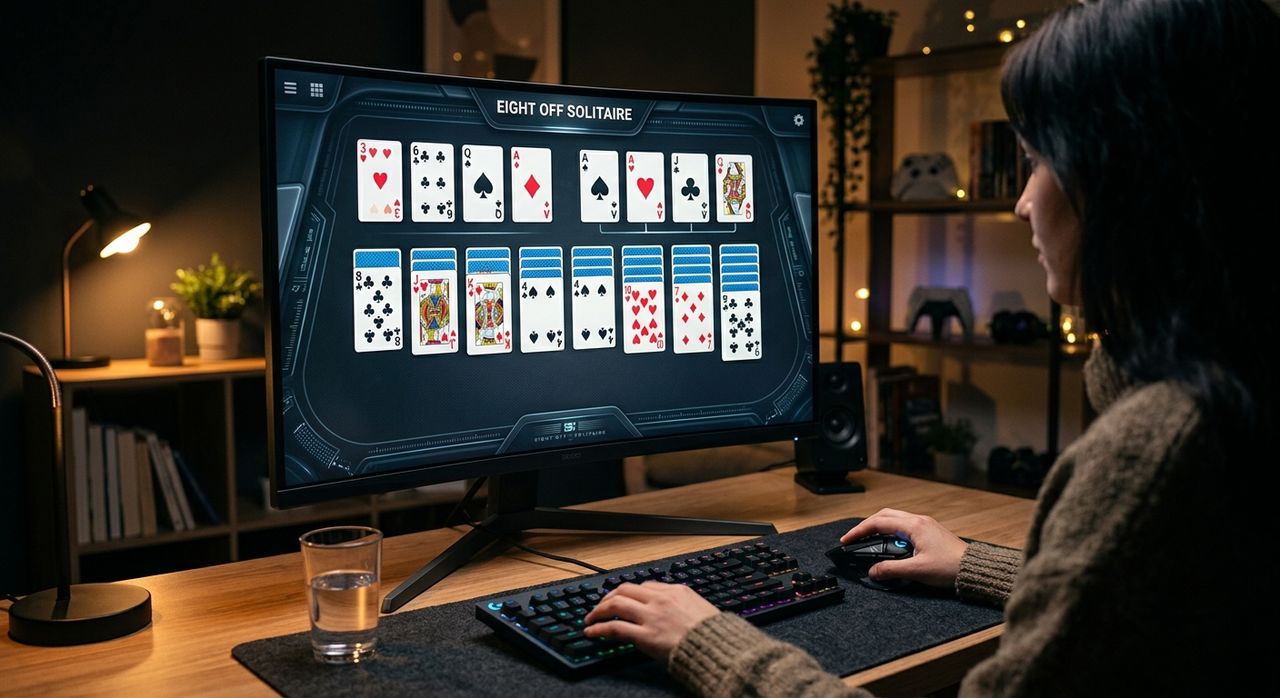
Most people think they know solitaire. They've clicked through Klondike a thousand times on a slow afternoon, maybe flirted with FreeCell when a stubborn column refused to cooperate. But there is a card game sitting quietly in the background that experienced players consistently call the most satisfying logic puzzle in the genre, and it barely gets the credit it deserves. Eight Off is that game. It rewards patience, punishes lazy moves, and delivers the kind of clean, deliberate satisfaction that most digital pastimes completely fail to offer.
Key Takeaway: Eight Off is a solitaire variant that builds on the FreeCell formula but tightens the rules considerably. It limits your reserve cells, forces strict same-suit sequencing on the tableau, and rewards forward planning over reactive clicking. For PC users looking for a genuine mental workout between tasks, it sits in a sweet spot between approachable card game and logic puzzle, and it runs in any modern browser without requiring an install or account.
What Makes Eight Off Different From Standard Solitaire
To understand why Eight Off stands apart, it helps to know where it fits in the broader family tree. FreeCell, the game most people compare it to, has a well-documented history tracing back to Paul Alfille's 1978 computer implementation. Both games use a full 52-card deck dealt into columns, with additional reserve spaces to temporarily park individual cards.
But Eight Off changes the rules in ways that matter immediately. In standard FreeCell, you can stack cards on the tableau in alternating colors, which gives you meaningful flexibility. In Eight Off, that flexibility is gone. Stacking only happens in the same suit and in descending order. That single change transforms the game from a moderately challenging puzzle into something that genuinely demands a plan.
Here is how a game actually begins:
- All 52 cards are dealt into eight columns of six cards each, with four cards left over.
- Eight reserve cells sit at the top of the board.
- The four leftover cards are placed immediately into four of those reserve cells.
- You start with only four open reserve cells to use freely.
- The tableau can only be built downward, one card at a time, within the same suit.
- The goal is to move every card to four foundation piles, built by suit from Ace to King.
That same-suit restriction is the difficulty spike. In FreeCell, a red six can go on a black seven regardless of whether it's hearts or diamonds. In Eight Off, a six of hearts goes only on a seven of hearts. Nothing else will do.
The Mental Texture of Playing Eight Off
Here is where the game gets genuinely interesting for PC users who spend most of their day in front of structured problems. Programming, data analysis, or any kind of layered troubleshooting has a specific mental texture to it. You hold a model of a system in your head, trace dependencies, and figure out what has to move before something else can move.
Eight Off mirrors that texture almost precisely.
When you look at a layout, you are not just thinking one move ahead. You are asking: if I park this card in a reserve cell, can I still free the card underneath it? Does clearing this column open a chain, or does it trap me three moves from now? The eight reserve cells look generous at first. But the same-suit sequencing rule means the tableau builds up in ways that refuse to cooperate, and those eight cells fill faster than expected.
This is not a game you win by clicking fast. A key insight from patience game theory) is that tighter rules push the skill ceiling dramatically higher, and Eight Off does exactly that. Players who debug code for a living often take to it unusually fast. The mental profile of a winning session looks like untangling a nested function call: identify the deepest block, figure out what's holding it, and work backwards to create the conditions for a clean resolution.
Why Browser-Based Play Fits a PC Workflow
One of the practical arguments for Eight Off over other brain-game options is pure accessibility. You don't need to install anything. No launcher, no account, no storage footprint on your SSD. The game runs entirely in a tab, which means it fits naturally into a working day rather than competing with it.
Playing eight off solitaire takes roughly fifteen to twenty minutes per game, which makes it a real break rather than a rabbit hole. It also disappears completely when you close the tab. No notifications, no streaks nudging you back in, no progress bar tied to in-app purchases. Just the cards and the problem.
That matters whether you're on Windows or Mac. Chrome, Firefox, Safari, it loads and plays identically across all of them. There is no compatibility gap, no driver issue, no launcher to wait on while a meeting is starting in three minutes.
The Habits the Game Builds Without Announcing It
Some people dismiss card games as purely recreational. That is fair for certain games. Eight Off quietly develops habits that have real carry-over.
- Sequential planning: You train yourself to think three to five moves ahead before committing, because reversing a mistake is expensive.
- Resource management: Each reserve cell is a finite slot. Using one carelessly closes options downstream that you cannot see yet.
- Pattern recognition: Certain tableau configurations signal a blocked game early. Experienced players learn to spot them and respond before the damage is done.
- Comfort with constraint: Sometimes there is no clean path forward. You pick the least damaging option and rebuild from there. That tolerance is useful far beyond card games.
The game's tight constraint system means you practice these habits under real pressure, not in theory.
Getting Comfortable With the Rules on Your First Session
Coming from FreeCell or Klondike, the first game will feel slightly disorienting. The suit-sequencing rule breaks habits you've built. A few adjustments help:
Start by treating reserve cells as expensive, not free. The instinct from FreeCell is to park cards casually. In Eight Off, every occupied cell is a slot you cannot use for something more urgent later.
Then watch for same-suit run opportunities. When you see a chance to stack a three-card run in the same suit on the tableau, prioritize it. Those runs move as a block and reduce the individual cards you would otherwise have to shuffle one at a time.
Finally, track your aces. The foundation piles build from there, and an ace buried under a six-card column early in the game is a warning sign worth addressing immediately rather than hoping it resolves on its own.
When a Solo Puzzle Is Not What the Moment Calls For
Not every break calls for working through a single-player constraint problem. Sometimes a colleague is nearby and the right call is a competitive game instead. In those moments, a round of two-hand spades shifts the dynamic entirely from introspective planning to reading another player's decisions in real time. Bidding strategy, bluffing, and the social tension of a head-to-head card game are a different kind of mental engagement. Both modes have their place depending on what a particular afternoon actually needs.
Why Eight Off Earns a Permanent Tab on Your Desktop
The category of games worth having on a PC is wide. Most of it is built around stimulation rather than thought. Eight Off earns its place in a different category. It asks you to sit with a problem, study it without rushing, and make decisions you can actually justify before you make them.
That is not a common offer in casual games, and it is worth something.
Whether you play it between meetings, over lunch, or as a deliberate wind-down after a long stretch of focused work, Eight Off gives you a consistent mental experience. Hard enough to feel meaningful, short enough to finish in a single sitting, and accessible enough to return to tomorrow without any friction. For anyone who values their time at a desk and wants a game that respects that, this one makes a persuasive case.