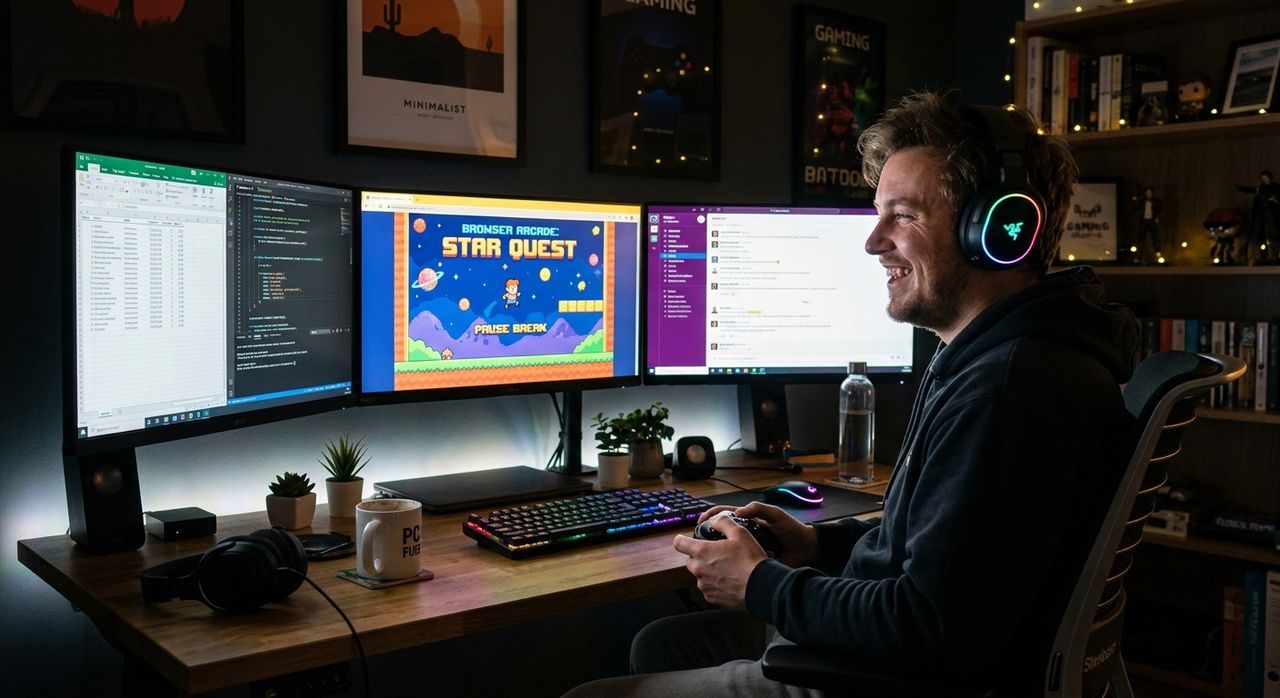
You sat down at 9 AM, coffee in hand, fully ready to crush your to-do list. By 2 PM, you are staring at the same paragraph for the fourth time, reading words that refuse to stick. Your cursor blinks. You type something, delete it, type it again. The work is there. Your brain just is not. This is not laziness. This is directed attention fatigue, and it affects virtually every knowledge worker who powers through an eight-hour session without a meaningful pause.
Key Takeaway:
1. Directed attention fatigue is a real cognitive phenomenon that degrades your focus within a few hours of sustained mental effort.
2. Passive scrolling does not restore attention, but structured, engaging activities like browser games genuinely do.
3. A single daily game challenge gives your brain a defined break with a clear endpoint, making it easy to stick to without losing the afternoon.
Why Your Brain Starts Failing in the Afternoon
Attention is not infinite. The prefrontal cortex, the part of your brain responsible for planning, focus, and filtering distractions, burns through its resources fast when you ask it to concentrate on complex tasks hour after hour. Researchers call this directed attention fatigue, and it shows up as slower reaction times, more errors, difficulty switching between tasks, and a growing irritability that makes everything feel harder than it should.
Most people respond by pushing through. Another coffee. Another tab open. Another Slack notification answered while trying to finish the report. But none of that actually restores anything. It just asks the same depleted system to keep performing. The result is that your afternoon output is a shadow of your morning output, even though you never technically stopped working.
The fix is not more willpower. It is smarter rest.
What Attention Restoration Theory Actually Says
In the 1980s, environmental psychologists Rachel and Stephen Kaplan proposed a framework that explains why certain kinds of rest genuinely restore cognitive capacity while others do not. Their model, known as attention restoration theory, argues that recovery happens when you engage a different kind of attention, one that is fascinated, effortless, and not taxed by demanding goals.
The key idea is soft fascination. Activities that hold your interest without demanding executive function allow directed attention to replenish. Walking in a park is the classic example. But a well-designed game on your computer can do the same thing, provided it meets the right conditions: engaging enough to pull you fully in, simple enough that it does not create its own cognitive load, and short enough to have a natural endpoint.
This is why games work where passive scrolling fails. Scrolling social media feels like rest, but it is actually a low-grade attention drain. You are constantly processing emotionally charged content, making micro-judgments, and feeding anxiety about what you might be missing. That is not recovery. That is just a different flavor of fatigue.
The Problem With Passive Scrolling
It is worth spending a moment on why scrolling has become the default break for PC workers, because it feels restful but mostly is not.
Social media and news feeds are specifically designed to hold your attention through novelty, urgency, and emotional stimulation. Every scroll is a bet that the next piece of content will be more interesting than the last. Your brain stays in a reactive, alert state. Heart rate stays elevated. The underlying cognitive tension does not drain. It accumulates.
When you look up from fifteen minutes of social media, you rarely feel clearer. You feel slightly worse, or simply numb. The afternoon still stretches ahead of you, and the mental fog has not lifted.
Games are different, specifically games that are self-contained, have a clear goal, and require a small amount of skill. These pull your mind into a focused but low-pressure state. You are not multitasking. You are not processing negativity. You are just playing, and that narrow, present-tense engagement is exactly the condition your prefrontal cortex needs to reset.
Why a Daily Challenge Format Is the Ideal Break Structure
Not all games are equal for recovery purposes. The goal is a break that has a clear start and a clear end, so you do not find yourself still playing forty minutes later wondering where the afternoon went.
This is where the structure of a daily challenge format genuinely shines. The dominoes challenge is a perfect example of this kind of break done right. It is a single daily puzzle you can finish in five to ten minutes, available without creating an account or downloading anything. It gives you a defined task with a satisfying endpoint, near-zero setup time so the break does not turn into a project, and a natural return point where you can go straight back to work. You load it, you play it, and when it is done it is done. There is no "one more game" trap because the daily format means there genuinely is only one game per day. That constraint is a feature, not a limitation. It keeps the break bounded and guilt-free.
Building a One-Game-Per-Break Ritual That Actually Sticks
The research on habit formation suggests that attaching a new behavior to an existing trigger makes it dramatically easier to maintain. For PC workers, this means pairing your game break with something that already happens in your day.
A solid structure to try looks like this:
- Take your break at the same time every afternoon, ideally between 1 PM and 3 PM when the post-lunch cognitive dip is steepest
- Close all other tabs before you start so the break is genuinely separate from work
- Play your single daily game, finish it, and close the tab before reopening anything else
- Give yourself sixty seconds to notice how you feel before diving back in
That last step matters more than it sounds. When you consciously register that the break helped, your brain builds a stronger association between the game and the feeling of relief. That is what turns a strategy into a reflex. Over time, you stop needing to talk yourself into taking the break because your brain already knows what comes after it.
How to Know Your Break Is Actually Working
There are clear signs that your structured game break is doing its job rather than just passing time.
You should notice that returning to work feels less effortful than before. The paragraph you were staring at earlier may read differently. Problems you were stuck on often resolve themselves during these micro-rests, partly because your brain keeps processing in the background while your directed attention is elsewhere.
You might also find that your error rate drops in the hour after a game break compared to the hour before it. If you track your work output even loosely, this is worth measuring. Many people are surprised by how significant the difference is once they start paying attention.
Signs the break is not working well enough include:
- Returning to work feeling more distracted or restless than before
- Having difficulty stopping once the game ends
- Finding the game so frustrating or competitive that it creates its own stress response
If any of those apply, the game is too hard, too open-ended, or too emotionally charged. Switch to something simpler and more self-contained.
The Real Cost of Skipping Your Break
Here is what most productivity advice gets wrong: it treats rest as a trade-off against work time. Every minute spent away from the screen is a minute not producing something. This framing misses the reality of cognitive performance curves.
A worker who takes two structured ten-minute game breaks during an eight-hour session does not lose twenty minutes of work. They likely gain two to three hours of sharper, faster, less error-prone output in return. The math does not favor grinding through.
Knowledge work is not like manual labor where effort correlates directly with output. Thinking quality degrades non-linearly under sustained cognitive load. A fresh brain working for six hours outperforms a depleted brain working for eight. The break is not the cost. The break is part of the investment.
This reframe is important because guilt is the number one thing that stops people from actually taking breaks. If you believe rest is a productivity leak, every pause feels like a failure. If you understand that rest is the mechanism that keeps your performance high, the break becomes as non-negotiable as a good chair or a decent monitor.
Your Afternoon Does Not Have to Fall Apart
If your afternoons have started to feel like a wade through deep water, the answer probably is not a bigger coffee or a longer to-do list. It is a short, structured pause that asks something different from your brain.
One game. One daily challenge. A clear endpoint and a clear return to work.
You are not abandoning your goals when you step away for ten minutes. You are protecting your ability to pursue them for the rest of the day. The people who finish strong on Friday afternoon are not the ones who pushed hardest Monday morning. They are the ones who treated their attention as a resource worth managing rather than a tank they could just run dry and refill overnight.
Take the break. Play the game. Come back sharper. Your afternoon output will thank you.