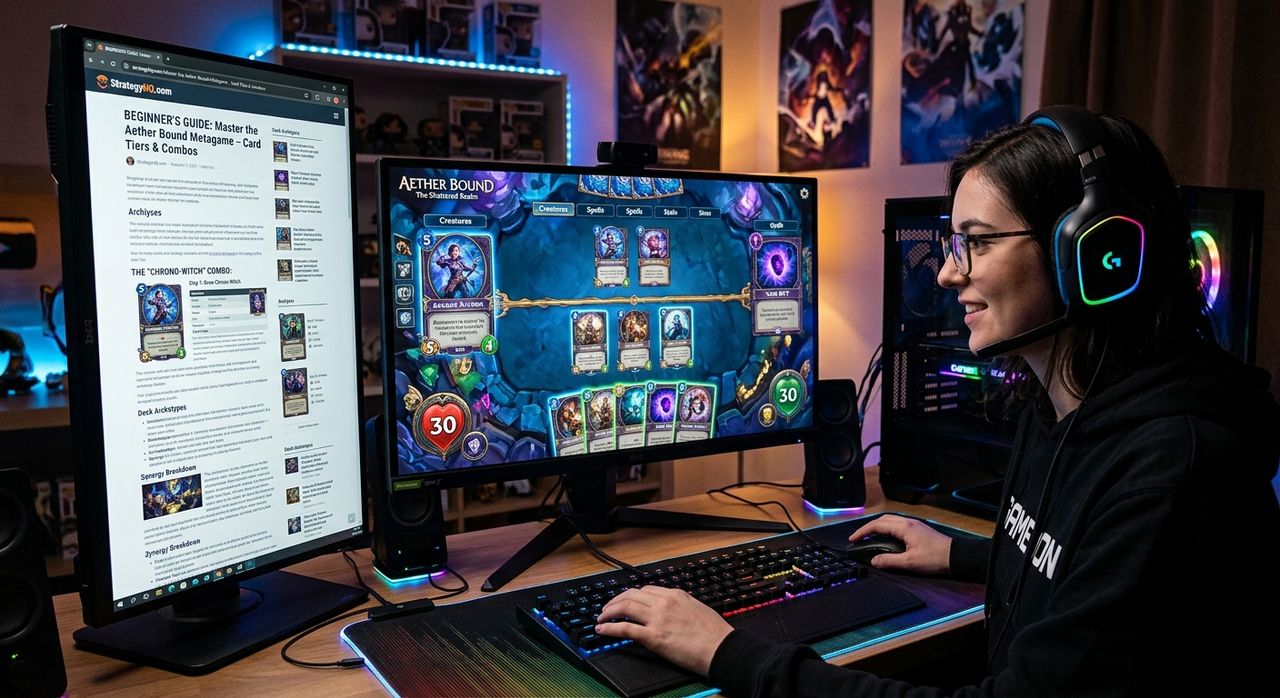
You've had Solitaire on your PC for years and you're bored of it. You keep thinking you should actually learn Gin Rummy or Hearts, but every time you search for how to play, you end up staring at a 20-minute YouTube video and closing the tab after 90 seconds. Sound familiar? You're not alone, and you're not lazy. You're a PC user. You read documentation. You skim README files, scan changelogs, and Ctrl+F your way to answers. The way you process information at a keyboard is fundamentally different from how a casual phone user watches a cooking tutorial. So why would you learn a card game any differently?
Key Takeaways:
- PC users and developers naturally absorb information by reading, not by watching, making text-based guides a better fit for learning card games.
- Browser FAQs are scannable, indexed, and referenceable while you play, which video tutorials simply are not.
- Gin Rummy is one of the best starter card games because its rules are compact and its strategy depth grows gradually.
- Structured online guides remove the guesswork from "what rule did I miss?" by letting you search for exactly the term you need.
- Moving from solo practice to live multiplayer opponents is the single biggest accelerator for skill development in any card game.
Why Video Tutorials Fail PC Players
Think about how you learned your last piece of software. Did you watch a two-hour walkthrough, or did you open the docs, find the section you needed, and start clicking? Almost certainly the latter. Video tutorials have their place, but that place is not in the middle of your first game when you are trying to remember whether you can knock with deadwood over ten.
Video content is linear. It forces you to consume information in someone else's order, at someone else's pace, with no way to search. If you miss something, you scrub backwards, lose your place, and start wondering if the host has always been this long-winded. The whole experience fights against the way most PC users already process information.
Text-based guides, by contrast, behave like documentation. They have headings, anchors, and structure you can scan in three seconds to decide whether this paragraph is the one you need.
The Documentation Brain and Why It Works for Card Games
There is a reason developers often describe good documentation as a skill accelerator. It is not just about the information, it is about the format. A well-built FAQ page lets your eyes jump to the relevant heading, read one or two paragraphs, and move on. No buffering, no timecodes, no waiting for the narrator to finish their anecdote about the 1940s before explaining what "meld" means.
Card games, especially strategy ones, have a lot of rules that are only meaningful in context. You will not care about the scoring for undercut until you are in a game and someone undercuts you. That is exactly when a browser-based FAQ is valuable, because you can flip to it, Ctrl+F the word you need, read the relevant paragraph, and close the tab. That loop takes about 15 seconds. Scrubbing a video to the right moment takes much longer, and you are still not guaranteed to land on the right explanation.
This is the core argument for structured online guides. They behave like living reference material rather than passive entertainment.
Gin Rummy as the Perfect Test Case
If you are going to test this theory, gin rummy is the right starting game. It has a compact ruleset, a clear objective — reduce your deadwood points by forming valid melds — and enough strategic depth to keep experienced players interested for years. It also has a well-defined vocabulary: deadwood, melds, sets, runs, knocking. A good FAQ page covers all of those terms in a way that a video tutorial buries under 12 minutes of background story.
The rules of this game, as traced in its history on Wikipedia, go back to the early twentieth century, and the core mechanics have barely changed since. That stability means the guides you find online are reliable. You are not learning a game that received a confusing update last week.
A structured FAQ gives you exactly what you need at the moment you need it: what cards constitute a valid meld, how to count deadwood, when you can knock and when you can go gin, and what happens when your opponent calls undercut. Those are four distinct questions you might need answered at four different moments in the same session. A FAQ page lets you jump between them. A video does not.
Browser FAQ vs. Video Tutorial at a Glance
| Feature | Video Tutorial | Browser FAQ |
|---|---|---|
| Searchable by keyword | No | Yes |
| Referenceable mid-game | Hard | Instant |
| Works at your own pace | Sort of | Yes |
| Jump to a specific rule | Requires scrubbing | Ctrl+F |
| Works without audio | Captions only | Always |
| Scannable in seconds | No | Yes |
The tradeoff is concrete. It is not that video tutorials are bad at teaching, they are bad at being used the way PC players actually use learning resources.
How to Use a Browser FAQ the Right Way
Getting the most out of a text-based guide is not complicated, but there is a method that makes it even faster. Open the FAQ page in its own browser tab before you start your first game, not after you hit a confusing moment. Skim the headings to build a mental map. You do not need to read everything, you just need to know roughly where the sections are so you can find them later.
When a confusing moment arrives in the game, switch tabs, Ctrl+F the word you need, read that section, and close the tab. That is the whole workflow. It is closer to checking a dictionary than watching a lesson, and that is what makes it effective under pressure.
The habit of treating a guide as reference material rather than required reading also prevents the worst mistake new card game players make, which is front-loading too many rules before they have played a single hand. You only truly understand card game rules once you have cards in front of you and something is at stake. The FAQ exists so you can look up the rule you need at the exact moment you need it, not before.
From Solo Practice to Live Opponents
Once you feel comfortable with the mechanics, something interesting happens. You stop asking "what is the rule?" and start asking "what is the right move?" Those are completely different questions, and no FAQ page can answer the second one for you. That answer comes from playing against other people.
Playing hearts online against live opponents is where everything you read in a guide starts to actually click. The Queen of Spades becomes a real threat when a real opponent is holding it and you cannot predict whether they are planning to dump it on you. The "avoid taking points" principle stops being abstract text and becomes a real decision you have to make under pressure with incomplete information.
The shift from reading about a game to playing it against live players is not a small step. It is where the real skill accumulation happens. Guides get you to playable. Opponents get you to good.
When the Guide Becomes Part of the Game
There is an underappreciated moment in every new player's journey where they stop reading the guide and start reading their opponent instead. That transition happens faster for people who learned from structured text references. The reason is straightforward. Reading a FAQ trains you to ask specific questions. Playing against people who learned from passive video reveals that many of them know what to do but cannot articulate why, because they absorbed the game by watching rather than by actively understanding.
PC users have an advantage here that they often do not recognize. The same habit that makes you good at reading technical documentation makes you good at using browser guides to learn card games. The same critical thinking that makes you a competent developer makes you faster at building card game intuition once you have the rules down cold.
Learning Smarter, Not Harder
The argument for online guides over video tutorials is not about being anti-video. It is about matching your learning format to the way your brain already works on a PC. If you spend hours a day reading docs, reviewing pull requests, and scanning error logs, you are already wired to extract information from structured text faster than from linear video.
Card games are not complicated enough to require a different approach. Gin Rummy, Hearts, Spades, Cribbage, all of them have rules that fit comfortably on a few well-organized pages. The best way to learn them is the same way you learn anything else at a keyboard: find a good guide, skim it for structure, reference it when you need it, and then go play.
The video tutorial will still be there if you want it. But you probably will not.