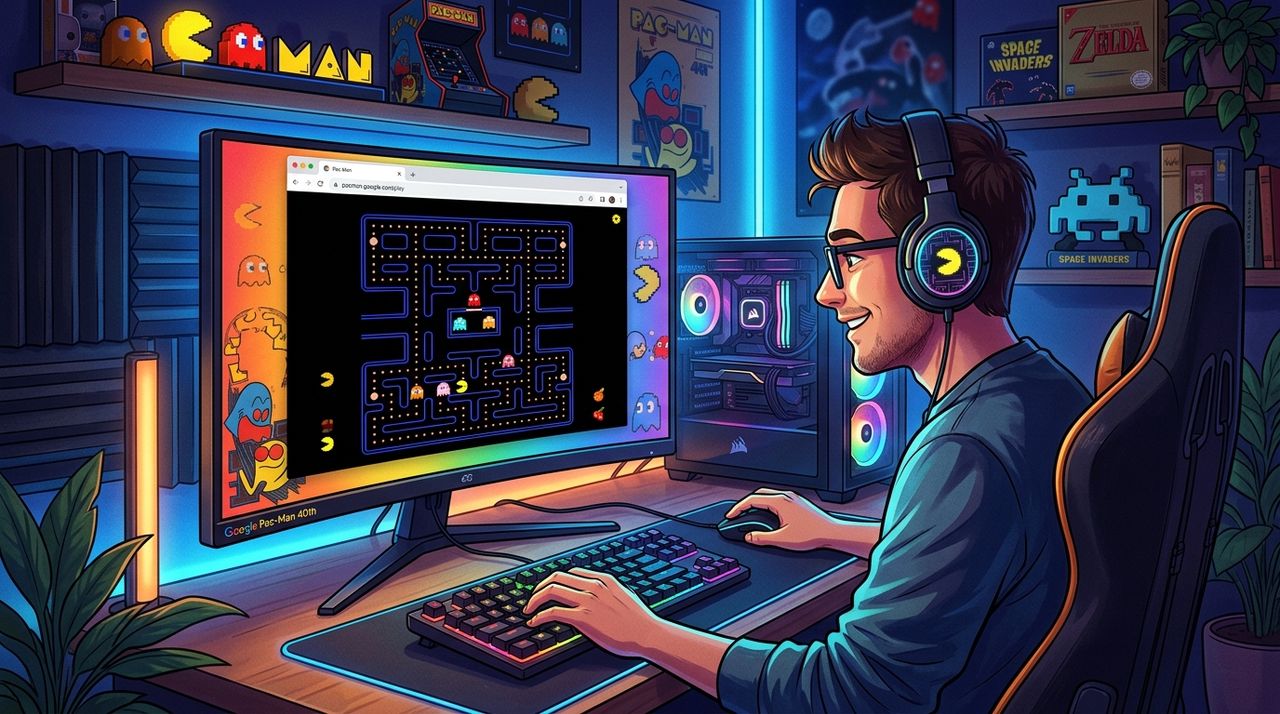
There is something about Pac-Man that refuses to age. The dot-eating, ghost-dodging loop that hooked players in 1980 arcade halls works just as well on a laptop screen today. Browser versions have come a long way, and if you have not tried one recently, the experience might surprise you. This is not nostalgia bait. It is a genuine test of the same skills the original demanded, running right inside Chrome or Edge without a download or plugin in sight.
Browser Pac-Man on PC is a closer match to the arcade original than most players expect. Here is what makes it worth your time:
- Ghost AI behavior mirrors classic arcade logic closely, including each ghost's individual targeting personality
- Chrome and Edge render the maze and sprite animations smoothly at modern resolutions with minimal input lag
- Survival variants extend the difficulty curve for players who have cleared classic mode too many times to find it challenging
A Game That Defined an Era
Pac-Man launched in Japan in May 1980, designed by Toru Iwatani at Namco with the explicit goal of attracting players who had been ignored by the shoot-em-ups dominating arcades at the time. Within a year, it had become one of the best-selling arcade games in history and reshaped what people expected from interactive entertainment. The full arcade history is worth reading for anyone curious about how a single screen and four colored enemies created a cultural phenomenon that is still being played in browser tabs four decades later.
The design was deceptively minimal. One maze. A fixed set of dots. Four enemies with distinct names and behaviors. A power pellet mechanic that briefly flipped the hunter-prey dynamic. And yet the combination felt alive in a way that few games matched. The ghosts were not random. That was the secret.
How Ghost AI Translates to the Browser
Each of the four ghosts follows its own targeting logic, and that logic creates emergent behavior players can study and exploit. The ghost targeting system) has been analyzed exhaustively over the decades, and it is one of the main reasons the game holds up under repeat play. There is always a new layer to understand.
Good browser implementations preserve this. They do not simplify the ghost logic to save processing cycles. The best ones replicate the original behavior faithfully:
- Blinky targets Pac-Man's current tile directly, chasing with increasing aggression
- Pinky aims four tiles ahead of Pac-Man's current facing direction, cutting off escape routes
- Inky uses a calculation combining Blinky's position and Pac-Man's direction, making him the least predictable
- Clyde alternates between chasing and retreating based on how close he is to Pac-Man
When you see Inky hang back while Blinky charges straight at you, that is not random variation. It is the same targeting logic from 1980, running inside a JavaScript engine in a browser tab. The fact that it still creates tension is a testament to how well the original system was designed.
Rendering in Chrome and Edge
Modern browsers handle 2D canvas rendering efficiently, and Pac-Man's visual requirements are minimal by today's standards. The maze scales without blurring, sprite animation stays crisp, and input latency is low enough that it does not interfere with split-second ghost avoidance.
Chrome tends to have slightly faster JavaScript execution due to the V8 engine, but Edge's Chromium base means performance is nearly identical in practice. If you have experienced frame drops in other browser games, Pac-Man will not give you that problem. The visual simplicity works in its favor.
A few things that affect the browser experience on PC:
- Keyboard input is more precise than touch on mobile, which matters when you are navigating tight corridors under pressure
- Running the game in a dedicated window rather than a crowded tab reduces the chance of background scripts causing hitches
- Fullscreen mode in most browsers scales the canvas cleanly without noticeable distortion
What Modern Variants Add to the Formula
Browser Pac-Man has moved beyond strict copies of the 1980 layout. Developers have introduced variations that keep the core mechanics intact while adding wrinkles that extend replay value. Some add speed modifiers that ramp up as you clear boards. Others introduce maze layouts the original cabinet never had. A few change the power pellet rules to make ghosts harder to run down once you flip them.
The interesting thing is that most of these additions feel native to the game rather than bolted on. Because the design is so tight, small changes create large shifts in how you approach each run. A maze with fewer straight corridors forces different routing decisions. Faster ghost speeds compress your reaction window significantly. The formula turns out to be more elastic than it first appears.
Survival Mode for PC Players Who Want a Real Test
If you have cleared classic Pac-Man boards enough times that the patterns feel automatic, the answer is not to find a different game entirely. The answer is to increase the stakes within the same framework. Playing pacman survival does exactly that. It is built for players who already understand the ghost logic and want a version that does not allow them to fall back on memorized routes.
Survival mode strips away the predictability that makes classic runs learnable over time. Ghost speed varies between rounds. Power pellet windows shrink. Maze layouts may shift between stages, forcing you to read the space fresh rather than rely on muscle memory. What made you competent at classic mode will not carry over cleanly, and that is the entire point of the mode. It tests whether you actually understand the game or whether you just memorized a solution.
For PC players, keyboard control gives you the precision that survival mode demands. You are pressing directional keys with tactile feedback rather than swiping on a glass screen. That matters when a ghost is three tiles away and you need to reverse direction without hesitation.
Why the Browser Beats Hunting for a ROM
There is a practical argument for playing Pac-Man in the browser that goes beyond simple convenience. Emulated ROMs require setup, compatibility checking, and often a controller configuration step that takes longer than the first game you play. Browser Pac-Man opens in seconds, requires no installation footprint, and closes with a tab.
The experience is also more consistent across PC hardware. A ROM running through an emulator can behave differently depending on your system configuration and the emulator version. A well-maintained browser implementation delivers the same result on any machine running a modern browser.
The Maze Has Not Gotten Smaller
Pac-Man in the browser is not a compromise version of a better game. For PC players, it is the most accessible form of one of the most carefully designed arcade games ever made. The ghost AI is intact. The rendering is clean. Keyboard control is genuinely well-suited to what the game asks of you. And if you want to push beyond what the classic layout can offer, survival mode gives you a harder challenge without asking you to learn a different game from scratch. You already know the maze. The maze just got more dangerous.