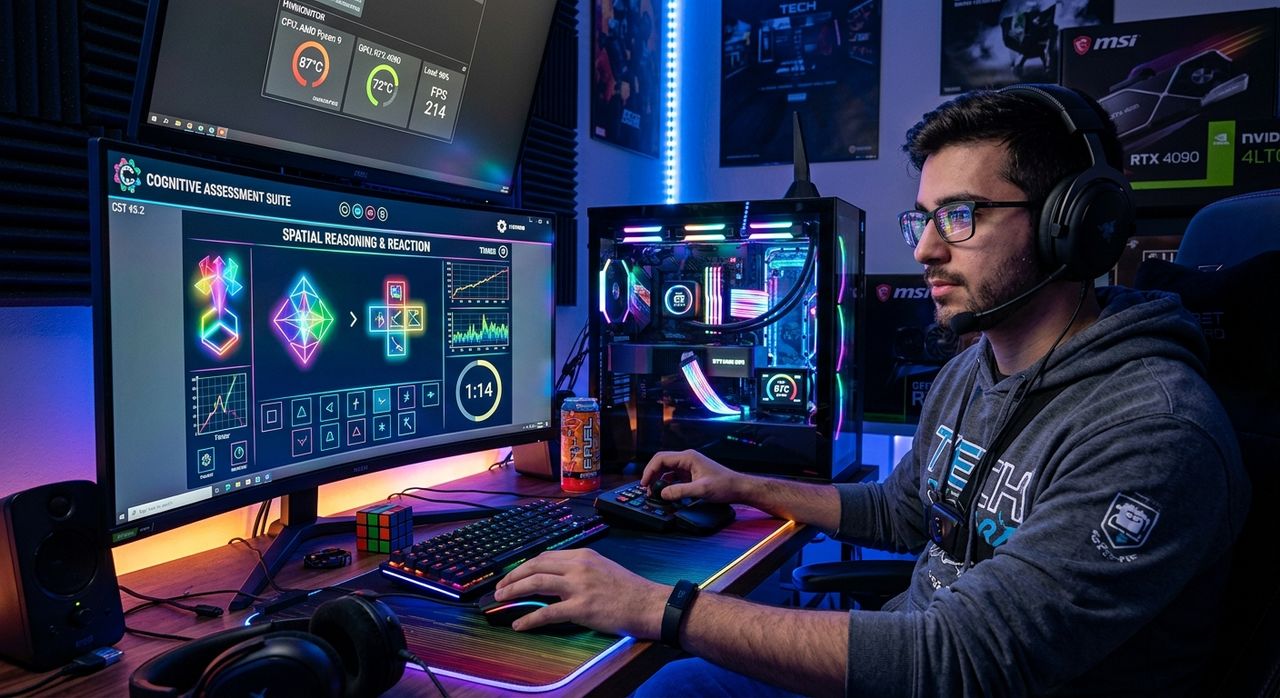
If you build PCs, you benchmark everything. You run Cinebench on the CPU, 3DMark on the GPU, and CrystalDiskMark on every drive before you even install Windows. You want numbers. Percentiles. Something you can compare against yesterday, against your last build, against your friends. That same obsession with measurable performance is now pointing inward, at the brain itself.
Key Takeaway:
1. PC builders are applying their hardware-benchmarking mindset to cognitive performance, using simple browser tests to generate real, trackable numbers.
2. Reaction time is the cognitive equivalent of CPU latency, a measurable stat that reflects the speed of your entire nervous system.
3. Working memory is a second measurable dimension, giving you a fuller cognitive baseline alongside your frame rates and drive speeds.
The Benchmark Mindset Goes Deeper Than Hardware
There is a reason PC enthusiasts love benchmarks. A benchmark removes the guesswork. It converts something vague, like "this feels fast," into something concrete, like "this is 12% faster than last month." That precision is satisfying. It is also useful.
The same logic applies to cognitive performance. Saying "I feel sharp today" is the equivalent of saying "my PC feels snappy." It is subjective, unverifiable, and impossible to track over time. A number changes all of that.
Cognitive benchmarking is not new in research settings. Psychologists and neurologists have used standardized tests for decades to measure attention, processing speed, and memory capacity. What has changed is accessibility. You can now run a meaningful cognitive test in a browser with no equipment, no registration, and no lab coat required.
Reaction Time: The Latency Stat for Your Nervous System
In PC hardware, latency is everything. Lower latency means your system responds to input faster. A 1ms monitor feels different from a 5ms monitor. A CPU with tight memory timings feels different from one with loose ones. You spend real money chasing those milliseconds.
Reaction time is the same stat applied to your biology. It measures how long it takes for a stimulus, something you see or hear, to produce a motor response. When you click a mouse the moment a screen turns green, that gap between the flash and your click is your reaction time.
According to the research on human reaction speed, a typical simple visual reaction time for a healthy adult falls somewhere between 150 and 300 milliseconds. That range exists because the signal has to travel from your eye to your visual cortex, get processed, and then send a motor command down to your hand. Every link in that chain costs time.
That chain is remarkably similar to the signal path inside your PC. Sensor input, processing latency, output command. The hardware just happens to be biological.
Running a reaction time test in your browser gives you exactly what a hardware benchmark gives you: a mean, a distribution, and a percentile rank against a large population of other users. You can run it multiple times and chart your improvement. You can test yourself after coffee versus after a bad night of sleep. You can watch the data move.
What Actually Affects Your Reaction Time
This is where it gets interesting for the tech crowd, because the variables are familiar.
- Sleep deprivation degrades reaction time measurably, often by 20 to 50 milliseconds or more, similar to how thermal throttling softens CPU performance under sustained load.
- Caffeine can reduce reaction time modestly in the short term, acting like a mild overclock on your alertness system.
- Sustained focus over time improves consistency even if it does not dramatically lower your best single measurement, much like how stable CPU voltage improves all-core performance across a long workload.
- Input lag and display latency on your own setup have genuine effects on how your brain calibrates expectation and motor response during the test.
The parallel to hardware optimization holds. You can tune the biological system. The benchmark tells you whether the tune is working.
Working Memory: A Second Cognitive Dimension Worth Measuring
Reaction time measures speed. But speed is only one hardware spec that matters. You would not buy a CPU based solely on single-core clock. You also care about cache size, because cache determines how much the processor can hold in fast-access storage before it has to reach out to slower memory.
Working memory is the cognitive version of that cache. It is the number of items your brain can hold in active, ready-to-use awareness at a single moment. According to the foundational research on short-term cognitive capacity, most adults can hold between five and nine items simultaneously, with the average clustering around seven.
That capacity matters in practical ways.
- Following complex multi-step instructions without writing them down
- Holding context while debugging a problem with many interdependent variables
- Tracking multiple objectives during a competitive gaming session
- Reading dense technical documentation without losing the thread three paragraphs back
Testing your number memory gives you a specific number: the longest sequence of digits you can accurately recall after seeing it briefly. That number is a solid proxy for working memory span, and it is exactly the kind of discrete, repeatable stat that PC enthusiasts find satisfying to track.
How Cognitive Benchmarks Fit Into a Performance Routine
Here is how a lot of people in PC communities are integrating these tests into their existing habits:
- Run reaction time and number memory in the morning before a gaming session or work block to get a fresh baseline for that day
- Re-test after significant lifestyle changes like switching sleep schedules, adjusting diet, or adding regular exercise
- Use the percentile data to set personal improvement goals, the same way you might target a specific Cinebench R23 score
One thing that makes this habit stick is the format. Browser tests are low-friction. You do not install anything, calibrate anything, or pay for anything. You sit down, run the test, get a number, and move on. The whole thing takes under two minutes.
The numbers also translate well into community contexts. If your group already shares hardware benchmark scores in Discord or a forum thread, adding cognitive stats to the mix creates a new dimension of comparison, one that is more personal and arguably more revealing than a GPU hierarchy ranking.
Beyond the Score: What Tracking Does to Your Thinking
Running these tests regularly does something subtle beyond generating data. It trains you to treat cognitive performance as a variable, not a fixed constant.
Most people think of mental sharpness as something you either have or you do not. But anyone who has benched hardware knows that performance is never fixed. It varies with temperature, power delivery, software state, and load. The brain operates the same way.
When your reaction time climbs by 30ms after four hours of sleep, the connection becomes difficult to ignore. When your number memory score drops on a day you skipped breakfast, the data is telling you something your subjective feeling might have smoothed right over.
That feedback loop is exactly what benchmark culture is built on. The measurement creates accountability. The accountability shapes behavior. The behavior changes the next measurement.
The Stats That Matter When You Know Your System
PC enthusiasts already speak this language fluently. Latency, throughput, cache, thermal headroom. These are not abstract ideas. They are tools for understanding a system and pushing it further.
Applying that same framework to the brain is a natural extension. The system just happens to be organic. The variables are different, but the methodology is identical: establish a baseline, run a test, record the output, adjust your inputs, test again.
The cognitive tests accessible through browser tools are not a gimmick or a novelty. They are a measurable window into something that affects everything you do with your PC, your work, your gaming, your problem-solving, your focus during a long build session. For a community that has always believed what gets measured gets improved, that is reason enough to add them to the rotation.