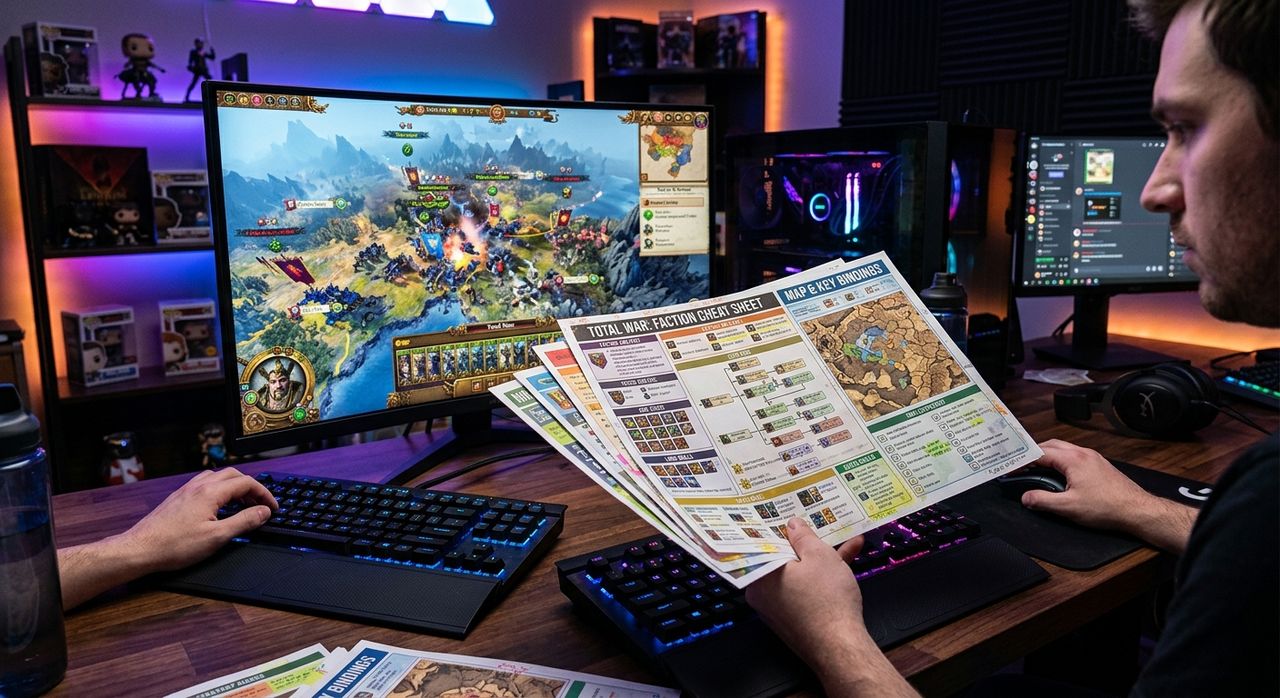
There is a surprisingly low-tech trick sitting inside the workflow of some of the sharpest PC gamers around. They print things out. A single sheet of paper placed beside the keyboard, or taped to the wall next to a second monitor, can compress hours of trial-and-error learning into something far more focused and deliberate. It sounds almost too simple, but the science of how humans learn supports it completely. The best players are not the ones who replay tutorials endlessly. They are the ones who keep the right information visible at exactly the right moment.
Strategy Snapshot:
- Printed reference sheets reduce cognitive load by keeping critical data accessible without leaving the game screen
- A second monitor paired with a physical sheet creates a three-zone learning environment that keeps attention where it belongs
- Probability-heavy games benefit most when bet summaries and odds are visible without hunting through menus
- Family-friendly hybrid setups use printed boards to eliminate the need for a physical game copy
- Skill acquisition accelerates when mental energy goes toward decisions, not information retrieval
The Problem with Replaying Tutorials
Most PC games offer some form of built-in tutorial. You play through it once, maybe twice, and then you are expected to have absorbed enough to get started. The problem is that tutorials are linear. They feed you information at a fixed pace, in a fixed order, and they disappear the moment you are done watching them.
When you hit a wall thirty minutes into actual gameplay and cannot remember whether a specific move costs one action point or two, your only option is to replay the tutorial or open a wiki in a new tab. Both options pull your attention completely away from the session you are in. You lose your train of thought. You lose the situational context. And you have to rebuild your mental state from scratch when you return.
This is a textbook example of what cognitive scientists call extraneous cognitive load, the mental effort spent on information retrieval rather than actual problem-solving. Reducing that load is the single most reliable lever for accelerating skill development in any complex activity.
The Second Monitor Is Already Half the Answer
Most serious PC setups already include a second monitor. People use it for Discord, for streaming dashboards, for keeping a browser open. But there is a more strategic use that competitive players have quietly adopted: dedicating that second screen to a live reference document.
The game runs full-screen on the primary monitor. On the secondary monitor sits a browser tab or PDF with a structured summary of the mechanics that matter most. No alt-tabbing. No breaking focus. The information is right there in peripheral vision, available the moment it is needed.
This setup alone is a significant upgrade over relying on memory. But the players who take it one step further are the ones who pair the digital reference with a physical printed sheet. That combination creates three distinct zones of attention, each serving a different function without any overlap.
Where Print Beats Digital for Reference
A printed sheet has properties that a monitor cannot replicate. It does not require scrolling. It does not lock you into a tab. You can annotate it with a pen. You can circle a specific row, cross out something that no longer applies, or write a personal shorthand note in the margin. The sheet stays exactly where you left it. It does not auto-lock, dim, or go to sleep.
For PC gamers who approach games analytically, this kind of physical artifact becomes part of the learning process itself. Writing on it reinforces memory. Having it nearby reduces the cost of a lookup to a one-second glance rather than a ten-second context switch.
Competitive players in strategy-heavy titles have been doing this for years. The practice of building personal reference sheets is common in chess, poker, and turn-based war games. What is newer is the ecosystem of printable resources built specifically for browser-playable PC games.
Probability Games and the Case for Bet Summaries
Table games played on PC are where the printed reference sheet pays off most dramatically. These games involve dozens of bet types, each with its own payout ratio and house edge. Keeping all of that information in working memory while also tracking the current game state and making real-time decisions is genuinely difficult.
This is exactly the scenario where having craps charts on the desk beside the keyboard transforms the experience. Instead of pausing to calculate whether a Place bet on a six carries better expected value than a Come bet in a given situation, you look at the sheet, confirm the numbers, and make the call without breaking the rhythm of the session. The cognitive space that gets freed up goes directly into reading the game more carefully and making better strategic choices. That is how analytical players get better faster.
The same principle applies to any game where probability and expected value matter. You are not removing the need to understand the math. You are removing the need to reconstruct it from memory every single time.
Hybrid Setups for Family-Friendly PC Gaming
Not every PC gaming session is a solo competitive grind. A growing number of players use their setups as a hub for family and social gaming, running browser-based adaptations of classic board and card games on a shared screen.
These hybrid setups introduce a specific challenge: you need the physical affordances of a board game (the tactile layout, the visual grid, the shared reference point) without the cost and storage requirements of an actual physical copy.
Printing a ludo board and laying it flat on the table beside the laptop or desktop solves this neatly. The browser session handles the dice and the scoring. The printed board handles spatial orientation. Players around the table can track their pieces on paper while the host manages the digital side. It eliminates the need to own a physical set and makes the experience feel grounded and tangible rather than purely screen-based.
What the Research on Skill Acquisition Actually Says
The fastest route to competence in any skill-based activity is a concept known as deliberate practice), a method that involves focused repetition with immediate feedback and constant adjustment. One of its core requirements is reducing the number of things competing for your attention so that each repetition is as clean and intentional as possible.
A printed reference sheet serves that function directly. When you are not spending mental energy on retrieval, every session becomes a purer form of practice. You are making decisions, not searching for facts. Over time, the information on the sheet migrates into long-term memory naturally, without rote memorization, because your brain has encountered it repeatedly in context.
This is why replaying tutorials is so inefficient by comparison. Tutorials are passive. They hand you information without requiring you to apply it under any real pressure. A reference sheet beside a live session does the opposite. It hands you just enough to act, and then makes you act.
Building Your Own Reference Sheet Practice
The habit is easier to start than it looks. A few approaches that analytical PC players have settled on:
- Print the sheet before the first session, not after frustration has already set in
- Keep the sheet beside the keyboard rather than behind the monitor, where it requires a head turn to read
- Use a highlighter on the rows or entries you access most often during the first week, then review those entries until they feel automatic
- Replace the sheet with a more condensed version once you no longer need most of it, keeping only the edge cases
The goal is not to depend on the sheet forever. It is a transitional tool. But transitions handled well are what separate players who plateau from players who keep improving.
The Setup That Actually Accelerates Learning
The combination of a primary game screen, a secondary digital reference monitor, and a printed summary sheet beside the keyboard is not glamorous. It does not require new hardware. It does not involve a subscription or a plugin. It is just a structured way of keeping the right information within reach at the right time.
For PC enthusiasts who approach gaming the same way they approach any complex skill, the printed reference sheet is the missing layer in an otherwise digital workflow. The screen handles the action. The second monitor handles the detail. The sheet on the desk handles everything that needs to be internalized, one glance at a time.