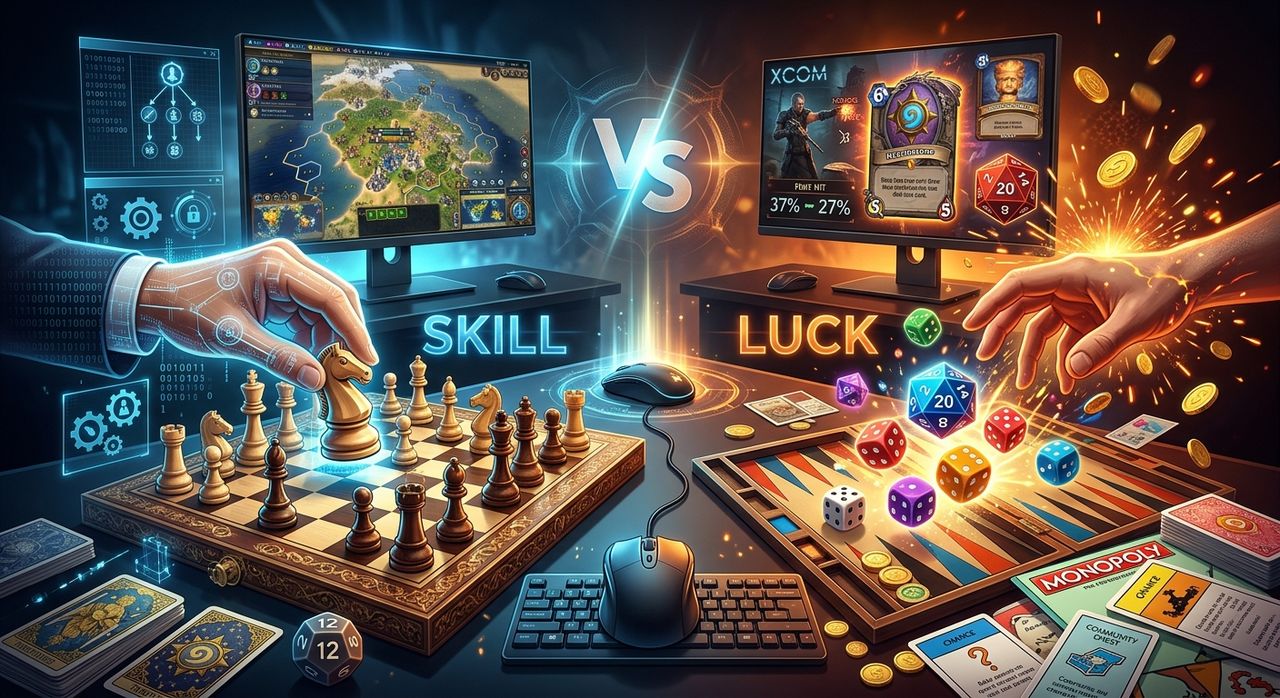
Most PC gamers have a finely tuned instinct for separating variance from skill. They track win rates, parse patch notes, and adjust mid-session based on what the numbers say. Then they sit down for a round of Ludo or Mahjong and suddenly feel like the outcome is completely out of their hands. That feeling is worth interrogating, because the skill-to-luck ratio in classic board and tile games is rarely what it appears to be at first glance.
Key Takeaway:
- Board and tile games fall on a spectrum, not at a single point of pure luck or pure skill.
- Game theory offers a formal way to measure how much player decisions actually shape outcomes.
- Ludo contains genuine strategic depth that its dice-based reputation obscures.
- Switching from bot play to live human opponents dramatically raises the skill ceiling.
- PC gamers who approach sessions analytically can identify which games reward long-term practice.
Why the Spectrum Matters More Than the Label
Calling a game "a luck game" or "a skill game" is shorthand, and shorthand is almost always imprecise. Game theory classifies games by the information available to players, the degree to which chance events can be countered by decision-making, and whether dominant strategies exist. Under that framework, almost every classic board game lands somewhere in the middle, not at an extreme.
This matters for PC gamers specifically because the mental model you already use in competitive titles, tracking variance against expected value, maps directly onto board game analysis. A loss in Chess is pure information about your play. A loss in Backgammon is a mix of dice variance and positioning error. Knowing which type of loss you are processing shapes how useful the post-game review actually is.
The Ludo Problem: Dice Do Not Tell the Full Story
Ludo has a reputation problem. Because it uses dice, most people file it under "children's game, no skill required." But that classification does not survive scrutiny.
The question of whether Ludo is really about luck or skill turns out to have a carefully reasoned answer. The dice cap what moves are available on any given turn, but they rarely reduce your options to exactly one. The real game happens in the choices you make within the constraint the dice create. Do you advance the token closest to home, or bring a new piece off the starting pad? Do you capture an opponent who just entered the board, or prioritize your own race? These decisions compound across dozens of turns.
Skilled Ludo players also manage risk across multiple tokens simultaneously, a form of portfolio thinking that will be immediately familiar to strategy game veterans. Weaker players pick the move that looks best in isolation. Better players pick the move that keeps the most options open several turns from now.
Classic Board and Tile Games Ranked by Skill-to-Luck Ratio
| Game | Luck Component | Skill Component | Verdict |
|---|---|---|---|
| Chess | None | Near-total | Pure skill |
| Checkers | None | Very high | Skill-dominant |
| Backgammon | High (dice) | High (position, risk) | Balanced |
| Mahjong | Draw randomness | High (tile reading, discard) | Skill-leaning |
| Ludo | High (dice) | Moderate (positioning) | Mixed, skill present |
| Snakes and Ladders | Total | None | Pure luck |
Information Asymmetry and Why It Predicts Skill Relevance
One of the clearest predictors of skill relevance in a game is how much information players have access to, and how differently skilled players use that information.
In Chess, both players see the entire board. Every decision is made with full information. In Mahjong, you see your own tiles and the discards on the table. You do not see what your opponents are holding. That hidden information layer is exactly where pattern recognition and probability estimation do their work.
The more information is hidden, the more a skilled player's edge comes from reading indirect signals. Tracking which tiles have been discarded, inferring what hands opponents are building, and adjusting your own strategy accordingly, these are the same cognitive skills that separate strong poker players from recreational ones. The asymmetry is not a flaw in the game design. It is the mechanism that creates skill in the first place.
What Changes When You Face a Human
Beating a bot in any board game is a fundamentally different exercise than beating a person. Bots play to an algorithm. Humans adapt, bluff, and make mistakes in unpredictable ways.
Here is what shifts in human-versus-human play:
- Psychological pressure affects decision-making in ways that pure probability cannot account for.
- Adaptive strategy means your opponent is modeling you as much as you are modeling them.
- Tempo manipulation becomes possible: slowing down, speeding up, or forcing errors through positioning.
- Bluffing and misdirection appear even in tile games, through deliberate discard patterns.
- Pattern exploitation rewards players who notice and respond to an opponent's tendencies mid-game.
None of these dynamics exist against a bot. The ceiling in bot play is fixed by the bot's algorithm. The ceiling in human play shifts upward every time you face a stronger opponent, which means the game keeps returning value no matter how good you get.
Mahjong Is Where the Ceiling Gets Interesting
Mahjong has a rich history, with tile game origins traceable to 19th-century China and centuries of accumulated strategic theory layered on top. The single-player or bot version teaches you tile mechanics well enough. The competitive version teaches you to read people.
Stepping into mahjong multiplayer exposes a dimension that offline play completely misses. You are no longer just optimizing your own hand. You are simultaneously managing what information you reveal through your discards, responding to the implied hands of three other players, and deciding when to push for a high-value win versus accepting a safe, lower-scoring one. That is three distinct analytical layers running in parallel, on every single turn.
For PC gamers who want a game where rigorous analysis is genuinely rewarded at scale, competitive Mahjong is one of the best tests available in the classic game space. It punishes lazy thinking in ways that a solo session never will.
The Data-Minded Player's Framework for Choosing a Game
If you are the type of gamer who keeps notes, reviews sessions, and tracks improvement over time, the skill-to-luck ratio is arguably the most important variable in choosing which game to invest in.
Pure luck games will never return on that investment. No amount of study improves your outcomes because there are no decisions to optimize. Snakes and Ladders is the clearest example: no player has ever improved at it, because there is nothing to improve. Mixed games like Ludo reward study at the margin, meaning dedicated practice will lift your win rate above average, but variance will still produce puzzling short-run results. Skill-dominant games like Chess or competitive Mahjong show your work most clearly: over a large enough sample, the better player wins more often, and post-game analysis connects directly to future performance.
That is the feedback loop that PC gamers are already trained for. The question is just which classic board or tile game gives you a loop worth running.
The Verdict the Data Already Knew
Classic board games are not a monolith. They are a collection of different experiments in the balance between what you control and what you cannot. Treating them that way, mapping them, studying them, and choosing them deliberately based on how much of the outcome you can actually influence, is exactly what the analytically minded player already does with every other genre they play.
The session data is there. The skill gap is real in more of these games than most players realize. You just need to decide which game is worth collecting it from, and now you have a framework to make that call.