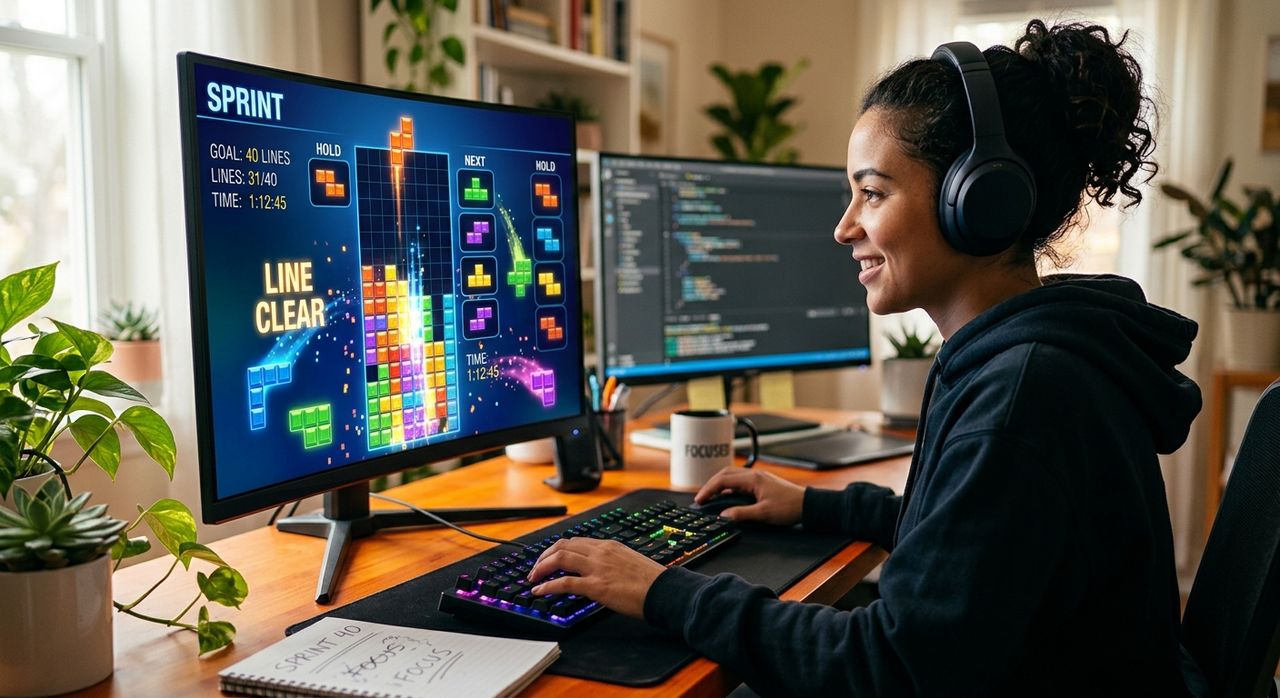
Every developer knows the feeling. You have been staring at the same function for forty minutes, your focus is gone, and the coffee has gone cold. The obvious answer is to take a break, but the usual options are not great. Scrolling social media pulls you into a rabbit hole. A walk takes twenty minutes you do not have. A meditation app asks you to sit still when your brain is buzzing. What if the answer was a two-minute game of Tetris, and what if that choice was backed by actual cognitive science?
Key Takeaway: Research published in peer-reviewed journals shows that short Tetris sessions actively reduce intrusive thoughts and cortisol, not by numbing the brain but by occupying just enough of it to interrupt a stress loop. Sprint mode, the game's timed 40-line challenge, adds a defined endpoint that keeps the break from becoming a time sink. Most clears take under three minutes, making it one of the few breaks that reliably ends on your terms.
What the Research Actually Says About Tetris and Stress
This is not wellness-influencer conjecture. Researchers at Oxford studied Tetris as a tool for disrupting traumatic intrusive thoughts and found measurable reductions in flashback frequency after play sessions. Separately, studies on casual gaming found that puzzle games reduce cortisol more effectively than passive activities like watching short videos. Tetris became the most-studied example because its visual-spatial demands occupy the same mental channels that process anxious rumination.
The mechanism is surprisingly simple. Your working memory has a limited capacity. Fitting L-shaped blocks into gaps uses the same visuospatial resources that replay stressful thoughts. You cannot do both at once. The game does not distract you from the problem so much as it physically evicts the stress response from the mental space it was occupying. The result is a few minutes of genuine cognitive rest, not avoidance.
This effect is well documented in research on the Tetris effect, which describes how the game's visual patterns persist in cognition and reshape mental activity even after play ends.
Why Developers Specifically Burn Out Differently
Knowledge workers, and especially developers, face a particular kind of mental fatigue. It is not physical tiredness. It is decision fatigue, context-switching overhead, and the constant pressure of abstract problem-solving. Regular breaks help, but the wrong kind of break does not reset anything. It just delays the return to focus.
Here are the signs that tell you a standard break is not cutting it:
- You come back from a five-minute scroll still mentally chewing on the same bug
- You feel less focused after your break than before it
- Your shoulders are tense but your mind feels overstimulated, not rested
- You keep checking the clock during your break because you cannot switch off
- You open a task, stare at it blankly, and immediately alt-tab away again
These are all signals that passive, open-ended breaks are not giving your prefrontal cortex the decompression it needs. Puzzle-based play does.
Sprint Mode: Why the Timer Changes Everything
General Tetris play has one big problem as a work break. There is no natural stopping point. You can lose track of ten, twenty, thirty minutes before you surface. That is not a break. That is a session, and it leaves you feeling more guilty about your time management than the original stress did.
This is where tetris sprint mode changes the equation. The format is elegantly simple. Clear forty lines as fast as you can. The game ends the moment you hit that number. For most players, that is somewhere between ninety seconds and three minutes. You never have the option to keep going. The endpoint is baked in.
That structure matters psychologically. Open-ended activities require willpower to stop. A sprint does not. It stops itself. You get the cognitive reset without the guilt of having spent twenty minutes gaming when you had a deadline an hour away.
How Sprint Breaks Stack Up Against Common Work Breaks
| Break Type | Defined Endpoint | Cognitive Load | Stress Reduction Evidence | Risk of Overrun |
|---|---|---|---|---|
| Social media scroll | No | Low, passive | Negative in most studies | Very high |
| Short walk | Loosely | Low, physical | Moderate, mood-dependent | Moderate |
| YouTube video | No | Low to medium | Mixed | High |
| Deep breathing app | Yes | Very low | Moderate, practice-dependent | Low |
| Tetris sprint mode | Yes, automatic | Medium, active | Strong, visuospatial research | Very low |
Sprint mode is one of the only break formats that combines a hard stop, active engagement, and peer-reviewed support for stress reduction. The "very low" overrun risk is the deciding factor for most developers who have tried it and gone back to it deliberately.
Building Sprint Mode into Your Work Rhythm
The most effective way to use sprint mode is not impulsively, when you feel yourself cracking under pressure. That works in a pinch, but the real productivity gains come from scheduling it deliberately.
A few principles that regular users report sticking to:
- Play one sprint at the end of every major task block, not in the middle of one
- Keep it to one or two clears maximum per session so you do not break the return-to-focus effect
- Do not check your phone, messages, or email between the sprint and getting back to work
- Use the sprint as a Pomodoro endpoint before a longer break, rather than a replacement for rest entirely
- Track your clear times loosely, as gradual improvement gives the session mild goal-oriented satisfaction that passive breaks cannot match
The data point that surprises most new converts is the return-to-focus speed. Unlike a YouTube video that leaves you in a half-attentive state, a completed sprint tends to bring you back with a noticeable sharpness. The task you left feels cleaner when you return, not because you solved it, but because your brain stopped chewing on it for two and a half minutes.
The Case for Breaks That End Themselves
There is a broader productivity principle buried in all of this. Breaks with no defined end are not breaks. They are avoidance with extra steps. The reason developers often feel guilty about gaming during work hours is that they associate it with endless sessions, not structured pauses.
Sprint mode reframes what gaming during work even means. It is not a session. It is a rep. You do one, you are done, you move on. The game enforces the boundary so you do not have to spend mental energy enforcing it yourself.
That is the part that actually sticks with people after they try it. It is not just that the stress goes down. It is that the break itself does not create a new anxiety about wasted time.
When Two Minutes Is Enough to Save Your Afternoon
There is a version of the workday where your afternoon is recovered by a two-minute game. Not because games are magic, but because the right amount of structured cognitive engagement at the right moment is genuinely powerful. The research backs it. The format enforces it. The only variable is whether you are willing to replace a mindless scroll with something that actually works.
For developers who live and die by their focus, sprint mode is worth treating as a tool, not a treat. Two minutes, forty lines, then back to the terminal. That is the whole protocol. Most people who try it once do not go back to social media scrolling on their breaks.