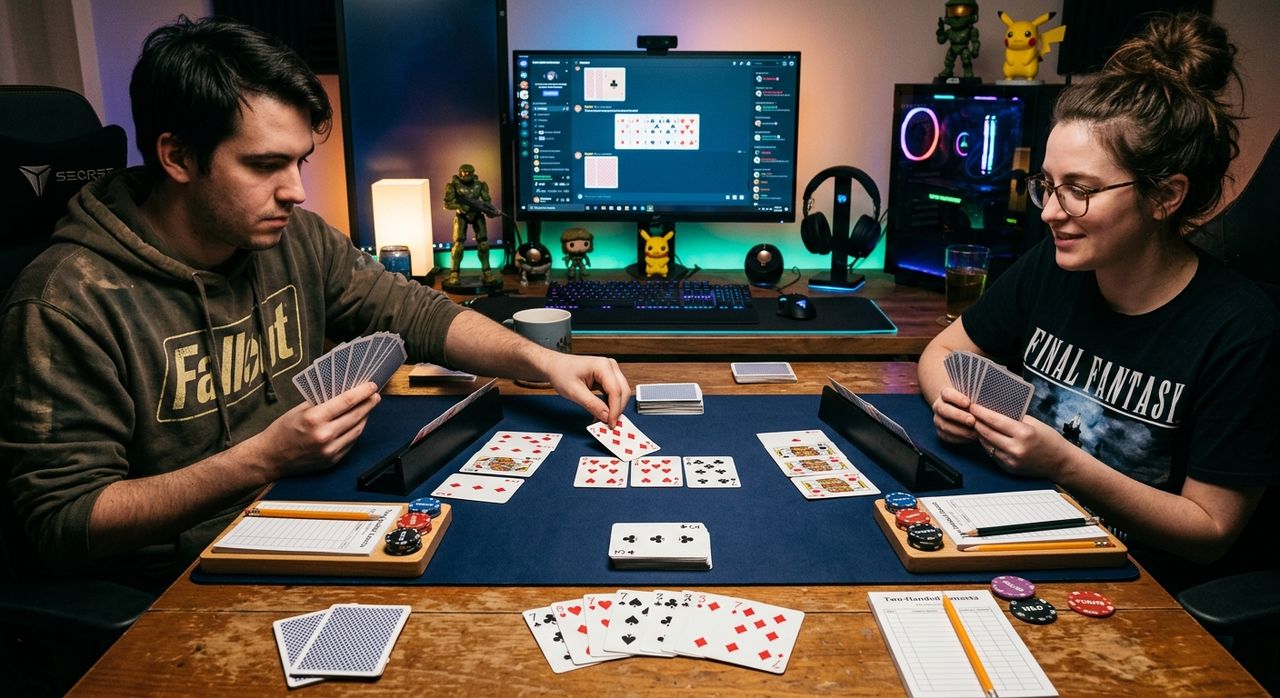
Most browser games built for PC users lean hard on reflexes. Click fast, react faster, survive longer. Two-handed canasta asks for something entirely different. It asks you to think ahead, track probabilities, and manage information under pressure, which turns out to be a much better fit for the kind of person who opens task manager before launching a game just to see what is eating RAM.
Two-handed canasta is a pure strategy card game that rewards analytical thinking over reaction speed.
- Each player handles all meld decisions, discard pile strategy, and timing entirely alone, with no partner to fall back on.
- The format removes team dynamics and creates a clean test of card-reading skill and risk tolerance.
- A full game fits comfortably under 30 minutes, runs in any browser, and requires no download or account.
Why PC Gamers Tend to Skip Card Games
There is a gap in what most PC gaming communities talk about. Hardware specs, optimization guides, competitive shooters, and survival sandboxes dominate the conversation. Card games rarely come up, even though a large portion of PC users grew up with solitaire and Freecell running in the background during downtime.
The assumption is that card games are passive, low-stakes, or something you only play when the real stuff is not available. That assumption collapses once you understand how much genuine decision theory sits underneath a game like canasta.
Canasta originated in Uruguay in the 1940s and spread rapidly across North America through the 1950s. According to its documented card game history, it briefly displaced bridge as the most popular card game in the United States. That popularity was not accidental. The game has enough depth to sustain serious competitive play and dedicated rulebooks that are still in use today.
What Makes the Two-Handed Format Different
Standard canasta is a partnership game. Two teams of two players share strategy, and a lot of the cognitive weight is distributed between partners. Signals, cooperative meld timing, and team conventions all shape how the game plays out.
The two-player format strips all of that away. What you get instead is a leaner, more direct game. The key differences are worth laying out clearly:
- No partner to bail you out when your hand is weak
- No teammate to scoop the discard pile when you are not positioned to
- Every freeze decision, every early-out calculation, and every meld sequence belongs to you alone
- Opponent behavior is the only external variable, so reading it becomes essential
- Wildcards matter more because no one is around to compensate for poor wildcard management
That shift changes the texture of the game completely. You are not reacting to a shared strategy. You are building one in real time, from imperfect information, against someone doing exactly the same thing. The game gets tighter and more personal.
Playing two-handed canasta against an online opponent captures this well. The interface enforces rules automatically, keeps the card state legible at a glance, and lets you focus entirely on the logic of the hand rather than managing a physical deck.
The Core Mechanics Worth Understanding
If you have never played canasta before, the structure is accessible even if mastering it takes time. The goal is to build melds, which are sets of three or more cards of the same rank. A seven-card meld becomes a canasta and earns a bonus. Wildcards can fill gaps. The discard pile can be claimed under specific conditions, and doing so can swing the momentum of a hand instantly.
Before your first session, these five things are worth knowing:
- You need at least one natural canasta (no wildcards) and one canasta of any kind before you can go out.
- Wildcards are powerful but costly to overuse. Too many in a meld reduce its point value.
- The discard pile starts frozen each hand. You can only take it if the top card matches a natural pair in your hand.
- Minimum meld requirements scale upward as your score climbs, which adds a timing pressure to early decisions.
- Going out early is not always correct. Staying in to build more canastas often outscores a fast exit.
How This Fits Into a PC User's Routine
The strongest case for canasta as a browser game for PC users is the cognitive reset argument. Short mental breaks are well-supported as focus-restoration tools, but not all breaks deliver the same result. Passive scrolling tends to extend mental fatigue rather than relieve it. A structured game with clear rules and a definable win condition gives the brain a different kind of task without the weight of work still attached to it.
Canasta works specifically well for this purpose because of how it engages attention:
- Long enough to pull you fully out of a work problem, typically 15 to 25 minutes per hand
- Short enough to fit inside a standard break window without bleeding into a work session
- Challenging enough to require genuine focus, which blocks task-related thoughts from looping in the background
That profile is different from reflex-based browser games, where the challenge is physical and the stress response is active. Strategic card play tends to produce a calm, focused state rather than a stimulated one. That makes the transition back to analytical work noticeably smoother.
Reading the Discard Pile as a Data Layer
One underappreciated skill in canasta is discard pile reading. The cards your opponent throws away are not just waste. They are a record of what ranks they cannot build melds around or have already abandoned. Tracking that pattern tells you what melds they are pursuing and, critically, which ones they are not.
In two-handed play, this becomes one of the sharpest tools you have. With only one opponent, every single discard is a usable data point. Skilled players treat the discard pile as a soft card-counting layer. If your opponent keeps throwing sevens across multiple turns, they are almost certainly not building a seven meld and probably do not have the cards to do it.
This kind of probabilistic inference feels natural to analytically minded PC users. It is structurally close to debugging, where you eliminate possible causes one by one based on observed behavior rather than guessing.
The Zero-Install Advantage for Security-Minded Users
PC users who are careful about what they install on their systems, which is a reasonable position given how much software bundles unwanted extras, tend to prefer browser-based tools and games for low-stakes activity. No installer, no background process, no registry change.
Browser canasta fits that profile exactly. You open a tab, the game loads, and you play. Nothing persists after you close the window. For users who treat their machines as optimized work environments and guard them accordingly, that kind of clean interaction model matters.
Two-Handed Canasta Is the Strategy Game Your Browser Tab Has Been Missing
The real argument for canasta is not that it is easy or low-effort. It is that it is engaging in a specific way that most browser games are not. It pulls your full attention without revving up your stress response. It rewards the kind of thinking that analytical PC users already do in their regular work. And it respects your time by fitting cleanly into a break rather than eating past it.
If you have written off card games as background noise rather than real strategy, two-handed canasta is the format that makes the clearest case against that assumption. The depth is real. The barrier to starting is not.